Monday, March 2, 2015

Jess' Top 10 - ICE Conference 2015

This has been my third year attending the ICE conference, and I can easily say this year has been my favorite (minus the snowy drive one of the mornings!)  I was part of a couple half-day workshops and some mini-sessions.  I participated in and listened to some discussions about a wide-range of topics such as: best practices with technology integration, global collaboration, digital writers, 1:1 devices, and technology that supports student engagement.

Below are my TOP 10 favorite ideas, quotes, images, or tools that made an impression on me, and that I hope will leave an impression on you as well!  These are in no particular order, however, I did put my FAVORITE item next to number one, so be sure to read all the way through.  All I have to say about the #1 item on my list is that it could be a game-changer!  

Now that I have your attention...let's begin with #10...

10. Ramsey Musallam is a high school chemistry teacher in San Francisco.  He's all about student learning, he's a "connected" teacher (uses social media), and he loves to get qualitative data from his students after each semester, plus he's a great speaker making it easy to listen to him at 3:00 PM after a long morning!  

He talked about the difference between being an Educator vs. Entertainer.  With the technology we have available it's easy to become an entertainer where we spend our day at the front of the room and impress our students with all of the exciting gadgets, tools, and videos.  However, the most effective approach to student learning is to let the students construct meaning for themselves through explorations and applications and then provide students with the information.  It's also important to build students' curiosity.  Ramsey mentioned asking students a question, but not giving them the answer...

Finally, he mentioned the importance of letting students struggle!  I'm going to leave you with a quote to think about...

"Difficulty builds mental muscle while ease builds only confidence" - Nate Kornell 
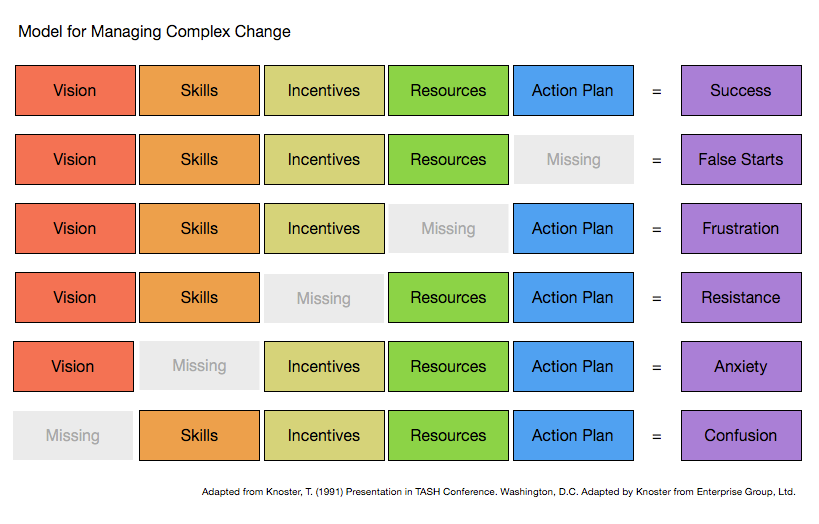

9.  We have been working through a lot of change lately (Thinking Maps, Kagan, Technology Integration, Words Their Way, etc.).  Here's a great graphic that outlines what we need (a Vision, Skills, Incentives, Resources, and an Action Plan) in order to avoid the purple column!


8. Throughout the year, send your students a Google Form for them to fill out anonymously that asks them questions about their perspectives of you as a teacher.  This a great way for you to collect some qualitative data about you as an educator!

7.  "If opportunity doesn't knock, build a door." This quote was shown in context with a slide about global collaboration. We don't often have the resources or knowledge of how to introduce and connect our students with others in the community, however, we have the ability to create that door ourselves! In fact, Google search "Digital Human Library" and you will find a collection of organizations and professionals ready to video conference with your students - FOR FREE!

6.  Want to connect your class with other classrooms around the world?  Check out Mystery Skype!

5.  Projects by Jen - this site is AMAZING! Visit this page to learn about World-Wide projects that your class can be a part of! There are projects happening at all times of the school year, so it's simple - see what project is coming up and decide if you want your class to join!

4.  Free writing can be as simple as allowing your students to "Tweet."  Maybe not using Twitter, but on a blog, or even on a post-it note, share a "hashtag" with your students and have them "Tweet" based on that hashtag!  Here are some hashtag examples...

#ihadthebestday (let students write about their best day ever!)
#allabouttheplanets (students can choose some planets to research and write about)
#uhoh (this can go in so many different directions...)
#canihaveyourautograph (write about someone you would like to meet)
#monkeysaliensandmonstersohmy (let them write creatively!)

3.  Every October our students have the chance to be a part of a Global Read Aloud.  Check out how we can connect with other classrooms around the world!

2. Support communication, collaboration, and students’ confidence as writers by showing them they have a Personal Learning Network (PLN). Use a Circle Map to help students create their PLN. In the center of the circle students will write Personal Learning Network, and around the circle students will list everyone that they can seek out for guidance in writing. Students can continue to add to their PLNs throughout the year This is a great way to let students know that their PLNs are always growing and more importantly that their parents, teachers, and friends/family are all part of their PLN!

1. You finally made it!  Click on this link and make sure to click on "watch this video"...prepare to be AMAZED!

Wednesday, January 14, 2015

Shhh!!! What is your Quiet Signal??

I am so excited to see how Kagan Fever has overtaken our school.  There are so many success stories that people have shared with me.  One of my favorite realizations that I've heard is how successful the quiet signal is!  Which, in my opinion, is one of the keys to starting Kagan successfully.

"I didn't think that it would work with my kids and they have totally caught on to it.  They enjoy "showing" the other students what the teacher is expecting!"

I am so glad to hear that there is success with such a simple technique.  Also, remember that it does not need to be the same signal that Jen, the trainer, showed us.  You can use your own.  Some of the benefits that come from using the hand signal is that you do not have to talk over the students to get their attention.  You don't need to walk over to the light switch to turn it off.  Another benefit is the ripple effect!  Some students see you raise your hand or hear your statement and then they help the rest of the class gain quiet attention.  How nice not to have to continue shushing the students or remind them that you are waiting for them.

Now here are some things that you should remember:

1.  Explanation to the students about the quiet signal is helpful!  Let them know that by placing them in groups, you are aware of the temptation to speak to others and of course with Kagan there are always opportunities for your voice to be heard!  Also, remind them that when working in groups, the volume throughout the room needs to be low enough that all the members in your team will be able to hear your voice.

2.  5 Seconds is Key!!  If students are taking longer that 5 seconds to give you their attention, then you should take time to practice the quiet signal with the class.

3.  Put your hand down before you speak! This is the one that I am always guilty of!!  I put my hand up, call for attention, and wait.  All good, right!  Then I keep my hand in the air and begin talking, WRONG!  I should model for them how I want them to give attention.  I do not want to confuse them.  We don't want them thinking that when my hand is in the air that I talk.  I know this is hard and as I said I always need to be aware of it too.

4.  Wait for the last hand!  If you get full attention from all but two or three students, do NOT continue.  Wait for the last hand!  If you continue, you are sending the message to the rest of the class that they really don't have to raise their hands.

5.  Awkward pause!  Remember that it is okay to let them squirm a little with anticipation with what is coming up next.  By allowing for an additional pause after the signal, you are sending a clear message that you will wait for silence before continuing to speak.


Watch for more Kagan tips in upcoming blogs!!  If you have a Kagan success story and would like to share it, please email me and I would love to add it to the blogs!

Wednesday, December 17, 2014

Kagan from a Tech Perspective

As a Technology Coach, do I get excited about Kagan Strategies?  YES!

I think back to all of the times that, as a third-grade teacher, I "incorporated technology" into the classroom.  As I think back, most of my technology integration consisted of either a group of students working in front of one computer or a group of six students each on their own device playing a math game.  If you had walked into my classroom while groups of students sat in front of a computer researching about a prairie animal you may have thought These kids are really busy learning.  Or, you may have walked into my room while students were playing math games and thought Wow, these students are SO quiet!

Let's think of my first example of "technology integration" in which I had groups of students all working on a classroom computer to research.  I now realize this was not the perfect scenario.  Granted this was 3-5 years ago and technology has dramatically changed.  I now see that having groups of students in front of computers inhibits many students from participating.  In fact, I can remember a few kids, one or two from each group, taking over the computer and the majority of the kids from each group sitting back for the ride!  This goes against all of Kagan's Basic Principles of Cooperative Learning - Positive Interdependence, Individual Accountability, Equal Participation and Simultaneous Interaction (PIES).  Most of the students were dependent on only one or two people in their group which meant about 25% of each group was participating and actively learning!

When thinking about my second example of "technology integration", in which students sat quietly with an iPad and played a game, I wonder now if many students enjoy this type of activity because they do not feel the pressure of accountability.  Honestly, how often did I check student progress on those drill apps?  Never...  Also, I question how this structure ever helped any of my students develop socially and emotionally!

Some people may think that it's difficult to integrate technology seamlessly when we only have about 10 devices per classroom.  However, in my opinion, this 2:1 model is almost better!  We are then made to group kids together in partnerships to work on meeting targets while using technology and we are pushed to use collaborative and critical thinking tools and apps such as Google Drive, KidBlog, and Explain Everything!  These tools not only support an active learning environment, but also a 21st Century Classroom!

Now let's get to the good stuff...a tangible example that connects Kagan and technology:

Target: Describe characters in a story (e.g., their traits, motivations, or feelings) AND explain how a character's actions contribute to the sequence of events. (3rd Literacy Grade Target)
Kagan Strategy: All Write Round Robin 
App/Tool: Popplet (an app for mind-mapping)
The Lesson: The teacher poses a question to groups of students - How many character traits can you think of.  Give the students some think time.  Each group has one iPad opened to the Popplet app.  The first person in the group starts a new Popplet and writes the word "traits" in the middle.  From there, each person says a trait aloud while also writing it in a Popplet off of the Popplet labeled "traits."  At the same time, everyone in the group is recording the trait on a sheet of paper as well.  In the end, each group should have about 8-12 traits listed.  Look at the image below to see an example:


This is just the start of a lesson about character traits...can anyone think of how to continue this lesson with the use of technology and Kagan strategies?  Or, does anyone have another idea for a different target?


Thursday, December 11, 2014

Assessing Language Targets with Technology by Jess and Lisa

Not sure how to report out on a language target?  We have an idea for you!  Each grade level is responsible for the following cycle 4 target related to sentence structure:

First Grade Language Target:
Demonstrate command of the conventions of standard English grammar usage when writing or speaking by producing complete simple AND compound declarative, interrogative, imperative, and exclamatory sentences when speaking AND writing in response to prompts

Second Grade:
Demonstrate command of the conventions of standard English grammar and usage when writing or speaking by producing, expanding, and rearranging complete simple AND compound declarative, interrogative, imperative, and exclamatory sentences when speaking and writing.

Third Grade:
Demonstrate command of the conventions of standard English grammar usage when writing or speaking by producing simple, compound, and complex sentences- ensuring subject-verb agreement and pronoun-antecedent agreement.

Fourth Grade:
Demonstrate command of the conventions of standard English grammar usage when writing or speaking by producing complete compound and complex sentences focusing on ordering adjectives within sentences according to conventional patterns (e.g., small red bag rather than a red small bag) and form and use prepositional phrases.

Fifth Grade:
Demonstrate command of the conventions of standard English grammar usage when writing or speaking focusing on verbs and conjunctions by using correlative conjunctions (e.g., either/or, neither/nor).

While we realize these structures may not always be found naturally in your students writing, there are other ways to determine if students understand these targets.

First, consider using a TECR Google Form as a way to pre-assess student understanding.  Then, from there, consider the many great tools that are available to help students practice these targets.  One such tool to use is Wixie.  With Wixie, you have the choice of assigning students a pre-made activity/template to complete OR give students the freedom to create their own Wixie to prove they understand this sentence structure target.   Please see the examples below:

Example 1: A pre-made activity/template to prove their understanding of sentence structure for first graders.


Example 2: A fifth grade student’s Wixie assignment to prove their understanding of sentence structure.


As always if you need support in understanding this target and/or learning how to use Wixie, please let Lisa or Jess know!

Monday, December 1, 2014

Make Sense of Problems and Persevere In Solving Them


"Successful problem solving does not mean that students will always conclude with the correct response to a problem, but rather that students will undertake a genuine effort to engage in the problem-solving process, drawing on learning resources described in the other practices such as appropriate tools, using their prior knowledge, engaging in math­ematical discourse with other students, and asking questions to make progress in the problem solving process. Successful problem solvers also recognize that powerful learning can be experienced even when an appropriate answer to a problem ultimately evades the student."
- Tim Kanold - Turning Vision into Action Blog


What do you do when you are presented with a difficult math problem? Try the problem below! Take note ,not so much to your solution strategy, but what you noticed about your perseverance. When was your perseverance tested? What did you do to overcome that? 

Jonathan is two years younger than his wife Hazel. Their current ages are both prime numbers. Next year Hazel's age will be a multiple of 11. Jonathan's age will be the product of two consecutive numbers. 

How old are Jonathan and Hazel?
(MATH FORUM Problem of the Week #3559)


*Want to know if you're correct? Email Sam your response and you may find a small gift in your mailbox! Correct or not, I applaud your problem solving and perseverance! 


What did you notice? Were you able to engage in the problem solving process as Tim Kanold described? 

Standard of Mathematical Practice Standard #1 states that students should be able to make sense of problems and persevere in solving them. How do we teach students to persevere and embed meaningful practice into our instruction?

When a student is presented with a challenging task, some students need help figuring out how to tackle that tough situation and need a lot of practice overcoming challenges.  Students need time experiencing productive struggle in order to build that ability to persevere. Productive struggle is when students explore tasks or problems with an appropriate level of support. Support, in this case, is asking the right questions or providing appropriate prompts to move the student forward without directly teaching them what to do.  This struggle is a balance between success and challenge that leads to increased motivation and confidence in a student's ability to be a problem solver. (See our previous blog post on Differentiation by Questioning for more information on what those prompts might look like!) 

As teachers, when our students struggle, we want to jump in and help, it's in our nature!  But, sometimes we need to avoid that temptation and provide our students with a different kind of support that builds their problem solving skills and, eventually, their confidence in math. 

Now, how do we allow for productive struggle without frustrating our students? Here are some tips for preparation and implementation:

Preparing to Implement Productive Struggle

  • Prepare students for struggle
    • Set classroom norms
    • Share why struggle is important
    • Create a safe environment for risk-taking
    • Model productive struggle and thinking strategies
  • Anticipate student difficulties
    • Instead of preventing difficulties, provide tools to help students work through difficulties
  • Differentiation
    • What provides productive struggle for one student may not for another
    • Ignoring this can lead to frustration for students
  • Response to feedback
    • Feedback on assessments and in-class work should require action from the student
Productive Struggle in Action
  • Focus on the process
    • Correct answers are not valid without explanation
    • Incorrect answers are a pathway to learning, not an impasse
    • Highlight multiple ways to reach the same conclusion
  • Allow access to tools
    • Do not limit the tools available for students
    • Let students decide instead of directing them how and what to use
  • Avoid over-helping or helping too early
    • Wait to intervene; look for non-productivity
    • Ensure students are doing the thinking
    • Use questions to guide instead of statements to direct
  • Learning when to help, when to question, when to wait
    • Reflect on the activity post-implementation
    • Promote student reflection and use reflection as feedback
(Closing the Achievement Gap Webinar - Edweb.net)

    Questions that Support Productive Struggle

    • How would you describe the problem in your own words?
    • How would you describe what you are trying to find?
    • What information is given in the problem?
    • Describe what you have already tried. What might you change?
    • Talk me through the steps you've used to this point.
    • What steps in the process are you most confident about?
    • What would happen if...?
    • Is it possible to...?
    • Is this always true...?
    • Why does this work?
    • What could you do next?
    • Is there more than one way to think about this?
    • What are some other strategies you might try?
    • What did you notice?
    • Could you explain what you mean by...?
    • What do we need to do to clear up our confusion?
    • Does your solution/conclusion make sense?


    This brings us back to Standard of Mathematical Practice #1 - Make sense of Problems and Persevere in Solving Them. By allowing opportunities for our students to engage in productive struggle, we can clearly see that most, if not all, of the key behaviors of this standard are embedded into our instruction. 

    Summary of Standard:

    • Interpret and make meaning of the problem to find a starting point. 
    • Plan a solution pathway instead of jumping to the solution. 
    • Monitor their progress and change the approach if necessary. 
    • See relationships between various representations. 
    • Relate current situations to concepts or skills previously learned and connect mathematical ideas to one another. 
    • Continually ask themselves, "does this make sense?" Can understand various approaches to solutions. 


    Tuesday, November 18, 2014

    Thinking Maps to Build Background...


    This is a great example of how students with limited English proficiency can fill out a Thinking Map.


    Building background for ELL students is an important step for their success in an up coming lesson. By allowing the students a chance to tap into the information and vocabulary that they already know about a topic you can help them to feel more confident as they approach the tasks associated with that topic. There are many ways to help students access what they already know about a topic and Thinking Maps are a great way to do this.

    Students can organize and fill in thinking maps no matter what their english proficiency level, it's just a matter of providing them with the right support. Above is an example of how a student with limited English can complete a circle map about living things. Although this students may not have the full grasp of the required vocabulary (in English) they can stay with what the class is doing and feel successful by using pictures instead. In this case the student is able to sort through what they already know about aquatic animals which will prepare them for upcoming lessons.

    Here are a few examples for the continuation to the circle map above.


    Thinking Maps are very basic in their structure but provide a wide range of opportunities to support students at various academic levels while having the  entire class all completing the same process for organizing their information. The ways that these can be utilized in the classroom is unlimited.


    Thursday, November 13, 2014

    Differentiation...Let me count the ways!!

    Differentiation is a district goal that we are strongly committed to.  We use the language to make sure that ALL of our students are learning, but how does that look in a classroom.  What are some ways that I can differentiate without having to rewrite everything I do?  I don't need one more thing to do! Differentiation does not have to be difficult or another thing added to your list.  There are 9 different variables that could be used to tweak the lessons you are already doing in your room.

    We will think of 3 boxes with 3 different ways to differentiate.  
    The first set of boxes are really looking at the "what" of our teaching.  First, is our sources.  How does this look?? You have different levels of students working on researching Prairie animals, but some of the students are more proficient with reading than others.  You may decide to change the sources in which your students research the topics.  One group may use books with clear headings and right there facts.  Another group of students may use websites directed by the teacher to find facts from.  These are two routes that have been altered or differentiated for your students.  What is the process you use to instruct your students? How do differentiate processes?  Think about the many ways that you can explain a topic to a student.  When you are teaching social studies, most times you are changing the process throughout the lesson.  You may read aloud the text to the students, you may have them read together and answer questions, you may have them read independently.  All three of these processes allow for our students to comprehend the material.  Finding which students work best with each process can sometimes be the more daunting task.  Differentiating your lesson by the process allows the students to learn in a style that either they prefer or that is helpful to them in comprehension.  The final "what" deals with the product that is created to demonstrate understanding.  Perhaps in your culmination activity, some of your students will write reports, some will make a poster, and some will make up a slide presentation.  This type of differentiation allows the students to show you what they have learned in a way that makes sense to them.

    The middle set of the boxes deals with "how" are we teaching.  The three ways are in whole group, small group, or individually.  I think the clearest example of this is in our guided reading lessons.  First, we may start the lesson with a whole group introduction to the comprehension skill of visualizing.  Some students may need another dose of that instruction and meet in a small group with the teacher to possibly have it explained in a different process.  Finally, those that are really struggling will need another individual session with the teacher. This middle set of boxes is the easiest way to differentiate and is what we most commonly see in the classrooms.  

    The final set of boxes really refers to the students that we are teaching.  We may need to differentiate lessons based on their readiness, interests, and information processing styles.  Often when we group our students for reading groups, we are looking at their readiness level.  At what level are they reading and who else is reading at that level?  Well, this same kind of process can be used to differentiate students in any lesson.  One thing to remember is that you don't just show readiness skills in reading and math!  Are your students at different levels in their communication skills, organization, attention, persistence, and academic background knowledge?  These may be other ways that you group your students when you are instructing in other content areas as well as in reading.  How do you differentiate by interest?  Have there been projects that you have given to students where you have allowed them to choose their topic?  This choice is often based on their interest in a topic.  Choice and interest often go hand in hand.  Choice and/or interest cannot always be a choice for differentiating.  However, have you ever tried looking at a math skill like measurement and ask students to think of a topic that they love and find ways that measurement relates to that topic.  For instance, my nephew LOVES dinosaurs, so he may choose to talk about how measurement could help scientist classify dinosaurs by their height.  Or maybe the length of their teeth would be helpful to know whether the dinosaur is a carnivore or herbivore.  Interests can be woven into subjects and can help create an interest in another topic when they see how it relates to something they love.  Finally, how do I differentiate by their information processing style?  Many of us have heard about multiple intelligences and how they can impact how a student learns.  This is a fun way to differentiate for students.  Again let's go back to having a project, but this time it is about Presidents.  To differentiate this project, we may give the choice of writing an essay for those linguistic students, create a song for musical students, create a collage for the artistic students, and possibly a game for those kinesthetic students.  In my mind, this third box really helps with differentiate for the needs of the students, but it also may effect one of the other boxes.  If we think of my last example with the presidents, we have differentiated by their information processing style, their interest, and their product.  Sometimes tasks lend themselves well to differentiating in more than one variable, but it does not need to.  I challenge you with your next activity, think of a way that you could alter one variable to differentiate to meet the needs of all your students.

    Sunday, October 19, 2014

    Differentiation by Questioning

    Differentiation by Questioning

    Prior to teaching a lesson, best practice shows us that taking the time to predict where students will struggle and plan ahead for how we will handle those situations will result in more effective instruction. While we're at it, why not plan ahead for how we can push the thinking of students who find success early on with a problem, activity or task?

    When we're planning an activity or task we often have 3 main groups to consider:
    A. Students who will struggle and need assistance.
    B. Students for which this task will be "just right" and will provide the perfect amount of challenge.
    C. Students who are higher level thinkers and will need more challenge. 

    One way to do this is by planning 2 sets of prompts that will either guide student thinking and help them overcome a challenge, or push student thinking about the concept to a deeper level. 

    Assessing Prompts (aka "Unstucking" Prompts) 
    These prompts serve two goals:
    1. Assess student understanding (Assessing)
    2. Help guide student thinking without providing an answer or teaching the concept.  ("Unstucking")

    Either way, our goal in using one of these prompts is to avoid teaching students and providing students with the answer. We want to ask thought provoking questions, help the student recall important information that they already know, and help them move in the right direction in order to find success with the task. As we're doing this, it is a great opportunity to subtly gather data as to student strengths and weaknesses regarding the skill and perhaps identify future areas of needed intervention or instruction.

    Advancing Prompts
    The purpose for these prompts is exactly what it sounds like - advancing student thinking!  These are a bit more difficult to come up with, but when we do, we can easily take an average level activity, and seamlessly challenge our students without having to create something new entirely new.

    Let's Try!

    Alex Says that when you multiply two fractions the product always gets smaller. Is he correct or incorrect? Why or why not?

    Assessing/"Unstucking" Prompts:

    • What do you know about multiplying fractions?
    • Show me how to multiply two fractions?
    • Can you think of a situation where that wouldn't be true?
    • What kinds of fractions do you know about?


    Advancing Prompts
    • What would the relationship have to be between the numerator and denominator to make Alex's statement ALWAYS true?
    • What situation would make Alex's statement false?
    • How could you reword Alex's statement to make it true?

    The time spent planning here was not on creating 3 different tasks, our time was spent taking something that may be a grade level expectation and making it suitable for students at various levels. This is one way to easily differentiate an assignment, task, or problem! Give it a try! 


    Friday, September 26, 2014

    Social Language Vs. Academic Language

    Do you have an ELL student who seems to speak perfect English?

    Social Language

    For many(but not all) ELL students listening and speaking in English are the first language areas that develop. For very new speakers they may go through a quiet period where they are quite apprehensive about using what they know. Once students begin speaking in English it can develop quite quickly but often they are primarily developing their social language. Social language is what they encounter consistently throughout their day. Whether they are talking to teachers or other students there are many words that they will hear over and over. This repetition of words and phrases builds the foundation of the student's language development. Many ELL students exhibit strong social language skills. This can be deceiving because they seemingly need less support in the content areas, when actually they have very little academic vocabulary.

    Academic Language

    Watch this video first...You will be tested on this information.

    Academic language, also called content specific language,  can be difficult even for native English speakers. Whenever someone is learning a new concept one on the first hurdles is to learn the vocabulary associated with that concept. This is true for all academic concepts that students encounter in school. For many native  English speakers this learning curve is less because they have often encountered many of the words before, but it can still be daunting. Academic vocabulary is not typically used in everyday conversations and may only be encountered in the school environment. For many ESL students (and English speakers as well) this vocabulary must be explicitly taught.


    For more information see these two articles:

    http://www.colorincolorado.org/educators/background/academic/ 

    http://www.ascd.org/publications/books/106048/chapters/How-Students-Acquire-Social-and-Academic-Language.aspx

    Tuesday, September 16, 2014

    Helping Your Students Become Problem Solvers


    Helping Your Students Become Problem Solvers!


    In order to become a problem solver, our students need to experience productive struggle and practice using what they know to persevere in solving a problem. What do we mean by productive struggle? Productive struggle is when a student is actually struggling with a problem or task; it's not easy for them! They should have some skills and tools to pull from in order to allow some success, but this task is not practice, this is an application of what they have already learned. We can go into productive struggle more on a later date! 

    This will help us build problem solvers by addressing one of our Standards of Mathematical Practices: 

    Standard of Mathematical Practice #1 - Make sense of Problems and Persevere in Solving them.

    One way to do just this, is by taking the well known gradual release model, "I Do, We do, You do" and making a small tweak! 


    "YOU Do, We Do, I Do" 

    Warm-up: Always be sure that the students have the background knowledge and the skills necessary to apply to a new situation. If you aren't sure, start with a warm-up that can activate their prior knowledge and remind them what they already know that can help them. Get those math brains going! 

    You Do: Provide the students with a problem they have never seen before that asks them to apply what they already know in a brand new situation. Choosing and crafting the right problem is key here as you don't want to cause frustration. Students should know just enough to be able to struggle through and feel that proud feeling of accomplishment at the end! If you notice some students reaching a point of frustration, have some prompts in mind that can frame their thinking and move them forward in the problem without causing them to shut down. But, do your best to NOT show them or tell them how to solve. 

    Debrief: Have students either share with a partner and/or share as a whole class to discuss strategies and how some students overcame certain challenges. Highlight interesting thinking, regardless of if it led the student in the right direction. Sometimes letting students explain their thinking and realize an error in logic on their own can be very powerful to that student as well as the whole group! 

    We Do (students): Ask students to complete a similar problem or a different problem with a partner. Allow students independent work time first to try to apply what they just learned from the debrief, and then call students together to compare their work and the strategies they used. 

    We Do (whole class): The "We Do" portion can be considered "we" as in partners or "we" as in whole class. It depends on what you think your students need. If students are struggling, you could pose a problem to the group and have them help you solve problem as a class in order to keep the task on track. 

    Debrief: Similar to above

    I Do: Now, take all the great thinking that the students shared and synthesize it into something concrete. If there is a specific algorithm or solution method you wanted to highlight, then connect it back to the student or students who shared those ideas. Some of the students in the class may not be totally clear at this point, they may have some ideas of how to solve the problem, but it's not solid. So, the teacher's purpose for modeling is to solidify understanding and clarify the steps that the students may have already discovered on their own! 

    Problem Solving Vs. Explicit Instruction

    When to Use Problem Solving: (You Do, We Do, I Do)
    - The students have skills that can be applied to a new situation. 
    - It's more about the thinking and not as much about the strategy being used. 
    - There are multiple strategies that could be used to solve a problem. 

    When to Use Explicit Instruction: (I Do, We Do, You Do)
    - Students do not have the background knowledge to be successful. 
    - You want to model your thought process in order for students to follow a similar thought process. 
    - You want to model a process that students are struggling with. 
    - Students must utilize a specific strategy that is brand new to them. 

    So, next time you're sitting down to plan a lesson, ask yourself if this is an opportunity to let the students practice being problem solvers! 


    Sunday, September 7, 2014

    What do I do with this Running Record?


    The running record is a helpful tool in determining an appropriate text complexity level for your readers. The miscues tell you what "tools" the student is using when he comes to a word he doesn't know.  They also tell you which "tools" he isn't using when he finds such a "road block."  This information is helpful to the teacher. It tells the teacher the student's strengths and it tells the teacher where s/he can help the student improve reading. 

    Once the running record is complete teachers can analyze to see which of these 3 "tools" (strategies) the student is using to figure out the unknown words:


    M = meaning.............(semantics) 
                                               Is the student trying to make sense of what is being read?
                                              what word would make sense here?
                                              read it the way the child read it / does it "make sense?"

    S = structure................(language / syntax)
                                             read it as the child read it / does it sound like the child 

                                             would "talk"?
                                             did the child furnish a noun, adjective, or an -ing word?
                                             does it "sound" right?
    V = visual....................(letter-sounds)

                                              Does the miscue look similar to a word in text?
                                              Does it have the same beginning sound?
                                              did he try to "sound it out?" even if he only got
                                                      the first letter-sound right
                                                      does it "look" like the word (beginning, middle, and/or end)

    SC  = self corrections........(self monitoring)
                                              this is a sign that reader is monitoring his reading
                                              working actively to make sure everything fits
                                              using semantics, structure and visual cues

    Let's look at some examples:

    semantics 
    Is he using:M - yes  (could make sense)
    S - yes (both are nouns)
    V
     - no (no attempt to 'sound out' the word, not even the beginning sound is the same)


    How to Help:This student is "reading for meaning."  He probably loves his books and happily discusses their content with you.  But, he is not attending to print.  We might say he is relying on meaning at the expense of visual clues.

    A teacher might ask this student to look again at this sentence.  She might point to the beginning sound and ask the child what the word might be....one beginning with the /s/ sound....
      She would encourage him to blend the beginning sound and look for the smaller word "or" within the larger word.  She might put him in texts that have more "decodable" words to better focus his attention on using his alphabetic principle (phonics skills).  She might encourage him to write more where he would have to look more closely at how words are spelled. She might ask him which page he likes best and then re-write one of those sentences on a sentence strip, have him read it, then chop it up and mix the words around to see if he can reassemble the words into a sentence (keeping it game-like and fun).


    semantics 
    Is he using:M - no (houses don't trot away!)
    S - yes (both are nouns)
    V
     - yes (look similar / beginning sound is same / although he obviously isn't very good at decoding, he is attempting to use this cueing strategy and we must give him credit for trying to use it.)


    How to Help:This child seems to be relying on visual cues at the expense of meaning.  He is not using semantics.  We might say to him, "Let's re-read that sentence....you said___, does that make sense?"  Keep it light and fun.  Don't make the reader feel bad.  It is a risk-free setting.  We are all in a learning mode. But we DO want to draw this student's attention to "making sense" as he reads.
     
    It's also important to periodically ask "Does this make sense?" when the reader has not made a mistake so that he doesn't understand it as a signal that an error has been made. It's important to develop a sense of self-monitoring with the reader.


    grapho-phonics 
    Is he using:M - no (nonsense words do NOT make sense)
    S - no (usually if nonsense word, usually syntax not being used either)
    V
     -yes (he is trying to 'sound it out' using the decoding strategy even if he still needs to look a little more closely)


    How to Help:Similar to the one above.  A teacher might say to this child, "Let's re-read that sentence...You said____, does that make sense?"  You can clearly see here that this student could use some more reading "tools" in his toolbox.  This child is over-relying on phonics; he needs to begin using semantics and syntax so that he can identify that word more quickly and move on.


    syntax 
    Is he using:M - possibly / use your BEST judgement and be able to tell why you made that informed decision. 
    Teachers do not always agree but they are usually close 
    and they try very hard to stay consistent from child to child.
    S - yes  (notice the -ing /seems to be some attempt)
    V - 
    yes (begins with "s" and ends with "ing" /indicates some use of decoding or letter-sound strategy)


    How to Help:A teacher might draw this student's attention to the beginning of the word, looking more closely and noting the word begins with "sh" / she might also point out that the sentence doesn't sound quite right.... or she may wait until this reader comes to another "roadblock" where it may be more obvious the reader is not using semantics before she makes her point. Teachers are selective about when best to make their move.


    Look for patterns in the reader's behaviors. Does the reader self-correct when meaning is disrupted? Is the reader relying too heavily on visual cues or not enough? Is the meaning of the passage being preserved? Interventions should be based on whether the student's miscues are significant to the whole meaning of the reading and the reader's greatest area of need. 

    Sources:

    Fountas and Pinnell Benchmark Assessment System
    Maury County School District- "What is a Miscue Analysis?"

    Friday, August 29, 2014

    PIES!

    It is about that time of year again for some yummy apple pie, pumpkin pie, pecan pie...mmmmmm!  That's not exactly the type of PIE that I am going to introduce you to today!  
    PIES is an essential part of the Kagan structures and is helpful when looking at lessons to decide if it is an engaging activity for all students.  Let's start with the basics of what each letter represents!
    P=Positive Interdependence
    This actually consists of two parts.  First, positive correlation where the success of one student is linked to the success of the other.  The best way to think of this is to think of two mountain climbers.  If one gets a good grip, he can better pull up the other.  When students' outcomes are linked, it encourages achievement and support amongst the students.

    Second, interdependence means students are mutually dependent on one another.  Picture two kids who want to build a skateboard.  One has a board and the other has the wheels.  Only if they work together can they reach their goal.  Each student knows and feels they cannot do it alone, but can do things together.
    I=Individual Accountability
    This occurs when an individual student is held accountable for some public display.  This eliminates the feeling that it is okay to hide and not be involved.  If we are going to gain in achievements for all students, each student must be held individually accountable for his/her own contributions and learning.
    E=Equal Participation
    If students are actively participating, they are processing the content, and are engaged and learning.  If they do not participate, learning is not guaranteed.  Participation is not voluntary.  Everyone must participate equally.  Again, this eliminates the feeling that it is okay to hide or to hog the conversation.
    S=Simultaneous Interaction
    If we are having students sequentially responding to questions, where only one student is answering a question.  You are typically only having 1/30th or 3.3% of the class participating at a time.  When you are using a structure like Timed Pair Share, you are having 1/2 or 50% of students participating at one time.  Huh?!?  Would you rather see that 3% or 50% of your students are learning and understanding what has been taught.

    By using PIES in your classroom, you are ensuring that your students are cooperatively learning and are truly engaged in their education.  When we go through new structures, try to think about how each of these components fit in.  I also challenge you to look at one of your own lessons and see if you have PIES throughout the lessons.